
What Is Positive Reinforcement Training?
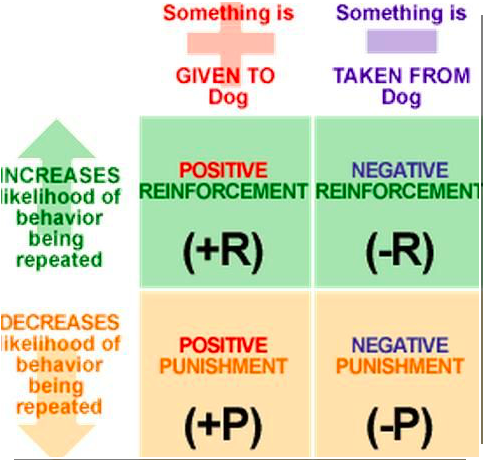
This chart helps explain the categories.
Positive reinforcement is actually a term that comes from behavioral psychology. It’s one of four categories that explain how to teach any learner a new behavior. What it literally means is you’re adding something (positive) to increase a behavior (reinforce). That’s all it is. Anytime the teacher adds something that makes the learner increase their behavior. When a child does well on a test, and they get a sticker as a reward, the sticker makes the child feel happy. Then, they are more likely to try hard on the next test to get another sticker. With animal training, we don’t use stickers, but often use food to reward the learner and make them feel good so they want to work hard with us and get another reward.
Positive Reinforcement trainers focus their attention mostly on this of the four categories of behavior. This is because even though you can use any of the categories to teach a behavior, modern studies have shown us that the more we can use positive reinforcement when teaching, the more happy, confident and relaxed our learners will be.
“ The use of positive reinforcement alone has been found to be significantly associated with a lower number of undesirable behaviors and reduced attention-seeking, aggression and fear (avoidance) scores. In addition, there is evidence that it may improve a dog’s subsequent ability to learn.” -Canadian Veterinary Medical Association
Another category is Positive Punishment. That is when you add something (positive) to decrease a behavior (punish). If a child draws on the wall with marker, and their parent yells at them, the child feels bad from being yelled at and is less likely to draw on the wall in the future. When teaching an animal, there are many products on the market that are deigned to use positive punishment to reduce behaviors we don’t like our animals doing. Positive reinforcement trainers don’t use positive punishment because it changes behavior by causing stress, fear and often pain.
“Such techniques create fear and therefore may increase the likelihood of a fear-induced aggressive response.” -The Canadian Veterinary Medical Association (In reference to +P training methods)
The other two categories are less popular to talk about, but still important. negative reinforcement is when you take something away (negative) to increase a behavior (reinforce). This is like when a parent constantly nags their child to clean up their room. When the child finally cleans the room, the nagging stops. If taking away the nagging is relieving for the child, they are more likely to clean their room more. In animal training this is another category positive reinforcement trainers don’t use because it would have to involve causing consistent stress, fear or even pain to an animal until they do what we want. This just doesn’t seem fair if we know there is a less stressful way to teach them to do the same behavior.
Finally, negative punishment is the fourth category. This is when you take something away (negative) to reduce a behavior (punishment). If a child is running around loudly with a new toy, and their parent takes away the toy, the child is less likely to run around loudly with a new toy in the future.
In animal training, this is actually something that sometimes happens in pairing with positive reinforcement. If a dog is chewing on a shoe, the trainer might take away the shoe to reduce the shoe chewing, but also give the dog a toy or something they should be chewing and praise them to reinforce chewing on something we want.
The four categories of behavior change is a very complex subject. I did my best to sum them up as simply as I could for this article, and I hope you found it helpful. If you are looking into positive reinforcement trainer, you’re looking for someone who’s goal is to teach animals without the use of stress, intimidation, fear or pain. Contact us to set up a consultation and we can make a training plan together to help you with your pet’s problems in a fear free way.